
What If The Moon ...
This is a post I initially wrote in 2013 after reading this io9 article about what the moon would look like if it was as close to Earth as the International Space Station is.
Here's a video from the io9 site:
The io9 article quickly points out that if the Moon were that close, it would break apart and form a ring (like Saturn's) because of the Roche limit. But let's assume the it doesn't break apart. I made a Geogebra animation showing a bird's-eye view of the Earth looking down at the north pole as the Moon and the ISS rotate around the equator.
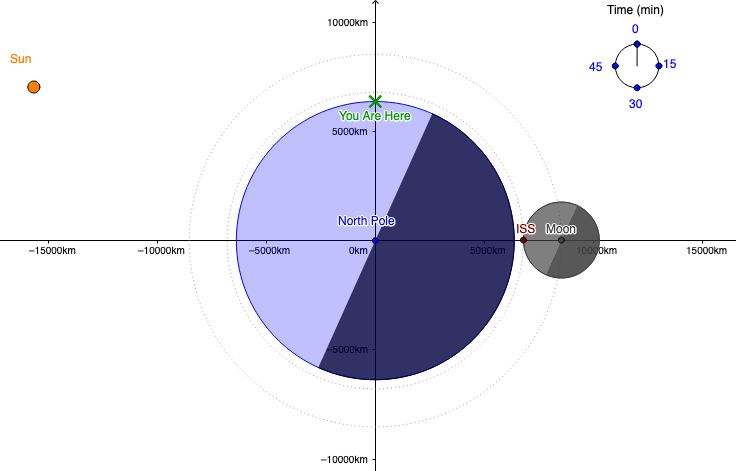
Geogebra Instructions:
- Click on the image to load the GeoGebra Applet.
- If you see an empty rectangle, click in the center to start the applet.
- Hit the “Press Play” button on the bottom left corner to start and stop the animation.
- You can move the Moon and the ISS manually without playing the animation.
- You can also move the Sun.
Note that:
- All the distances (except for the Sun) are to scale (the size of Earth, Moon, the orbits).
- The animation runs about 60 times faster than real life so that one second of animation is one minute of real time. The clock on the top right corner helps keep track of time.
- The changing darker shade on the Moon when it flies by represents the visible part of the Moon since the rest is hidden behind the Moon's curvature. It has nothing to do with sunlight.
Now let's try to answer a few interesting questions…
Period of Revolution
Why is the ISS going faster if the Moon is at the same distance?
Even though the surface of the Moon is 420 km away from the surface of the Earth (like the ISS), its centre of mass isn't, which means it's in a different orbit. It's not taking more time to go around because it's bigger and more sluggish. If that were true, the astronauts in the ISS would want to orbit faster than the station itself. That would be weird…
The only thing that affects orbital speed is the distance from the planet. The further away an object is, the longer it takes to go around it. For example, Neptune takes about 165 Earth years to go around the Sun because it's so much further away from it than we are.
So because the Moon's centre of mass is further away, it revolves around the Earth more slowly:
| Period of Revolution | |
|---|---|
| ISS | 1 hr 33 min |
| Moon | 2 hr 11 min |
Flyby Duration
How long would we see them in the sky?
Since the Moon would take about twice as long to go around the Earth as the ISS, it's reasonable to think that it would be visible for about twice as long. But that close to Earth, the Moon's size is very big, and if we calculate the time from when we “start” seeing it to the time when we completely lose it below the horizon, we would see it four times longer than we'd see the ISS!
At best (if they rise straight over us, and ignoring atmospheric and optical issues):
| Visible for at most | |
|---|---|
| ISS | 10 min and 30 sec |
| Moon | 41 min and 30 sec |


Apparent Size
I've seen the video, but how do you explain how it would “look” like?
During its flyby, the following three aspects change:
- The Moon's distance from us.
- The angular size of the Moon.
- The surface area of the Moon that we can see.


| At the horizon | Overhead | ||
|---|---|---|---|
| Distance from us | 1425 km | 420 km | (3.4x closer) |
| Angular size | 66.7° | 107.3° | (1.6x more) |
| Visible surface area | 22.5% | 9.7% | (2.3x less) |
Distance From us
Because the Moon is about 3.4 times closer to us when it's overhead compared to when it's at the horizon, we'd see craters getting bigger and bigger as the Moon rises.
Angular Size
As soon as the Moon is completely over the horizon, what we see would cover about 67° of our field of vision. To put this number into perspective, looking at the horizon and then looking straight up covers 90°. If the Moon was rising right behind the Eiffel tower (which is 300 m high), you'd only have to be 129 m away from the tower to see the Moon at the same eight as the tower.
As the Moon rises, the disk that we see in the sky would grow in angular size to 107° (1.6 times more). This is crazy! It means that looking at the horizon, we would only be able to see 36° of sky before we see the Moon. In every direction! It would be like being in a room where the ceiling is the Moon and the walls are open.
Surface Area
As soon as the Moon is completely over the horizon, we would see about 23% of its surface area (instead of about 50% for our real Moon).
However, as it rises straight overhead, what we see would drop to 9.7% (2.3 times less). That's because as it gets closer to us, more of the Moon's surface gets hidden behind its curvature.


What About Gravity?
- Since the Moon is so much closer, would we feel our weight change as it flies around the Earth?
- What about from the perspective of an astronaut on the moon?
I did quick back of the envelope calculations and found that:
- On Earth, gravity would increase by 0.2% when the Moon is on the other side of the Earth, and it would decrease by 0.7% when the Moon is straight overhead. I have no idea how much bigger the tides would be.
- On the Moon, however, it's a very different story! Assuming that the Moon is still tidally locked, an astronaut on the “far side” of the Moon would barely be able to stay on the surface, and an astronaut on the “near side” would fall towards Earth (although, I don't know if they'd fall *on* Earth or into a lower orbit…)